

Twenty-two Ways to Develop Leadership in Staff Managers
According to Robert Eichinger and Michael Lombardo, a person who works exclusively in staff jobs throughout a career is less likely to develop important leadership competencies than a person who works exclusively in line jobs. This report, published by the Center for Creative Leadership, shows why and offers several specific ways to increase the leadership potential of staff managers. The following four-part excerpt has been reproduced here by GovLeaders.org with the kind consent of the Center for Creative Leadership.
Introduction
First the bad news: A person who works exclusively in staff jobs throughout a career is less likely to develop important leadership competencies than a person who works exclusively in line jobs (or in a combination of staff and line jobs). Life as a staff professional is developmentally impoverished.The consequences of having developmentally deprived staff professionals are serious. It means it is more difficult to find strong staff leaders, with all the implications for staff performance that this entails. It means we are wasting future talent; the pool of potential leaders for senior management positions is being restricted because women and other minority executives, who have primarily entered organizations via staff positions, are finding it difficult to make it into the senior-potential pool. And it means that in many cases staff professionals, willing but unable to move into line positions, are being career frustrated.
The good news is that this needn't be the case. The development of staff professionals can be greatly enriched. It is essential we do so. Staff executives need to be full partners in understanding and running organizations. With the increasing complexity and rate of change that organizations face, the distinctions between line and staff executives are beginning to blur. Strong, broad leadership is needed to meet present and future demands. . . .
How Successful Executives Develop
Successful and effective leaders get to be that way by responding positively and adaptively over a long period of time to diverse but specific experiences. Basically, these can be grouped into five types:Challenging jobs. Challenging jobs—starting up something or fixing troubled operations, expanding large operations, working on time-limited projects from crises to systems installation—teach about the subtleties of leadership. These developmental challenges represent what leaders actually have to do. Such jobs teach how to cope with pressure, learn quickly, or deal with balky subordinates. In absolute terms, challenging assignments are the best teacher. They provide both the greatest variety and number of lessons requisite for executive leadership.
Bosses and other people. Bosses and other people, both good and bad, serve as significant role models for values. Exceptional people seem to create a punctuation mark for executives, either by representing what to be or to do or what not to be or not to do. Whether by serving as models of integrity or acumen, poor ethics or avarice, certain bosses exemplify how values play out in management settings.
Hardships. Hardships teach executives about their limits. These include making mistakes, getting stuck in dead-end jobs, enduring the traumas of life such as untimely deaths and tornadoes, and having to fire people. Regardless of the event, managers experiencing hardships will often look inward to reflect on their humanity, their resilience, and, most importantly, their flaws.
Coursework. Coursework can serve as a powerful comparison point, a chance to build self-confidence by sizing oneself up against managers from other organizations. Courses are also a place to trade tips, listen to war stories, and pick up different approaches to solving problems.
Off-the-job experiences. Experiences off the job, usually relating to community service, can be primers in persuasion. Each of these types of experience teaches something unique, and learning from a variety of experiences can lead to one's being a manager with balance, able to respond adaptively to a variety of challenges. For instance, the confidence built through successfully coping with challenging jobs can lead to arrogance unless tempered by a sense of one's own foibles and limits; this is usually learned through facing hardships.
Having a variety of experiences is a prerequisite for success. The flip side also holds. Not having a variety of experiences or failing to learn from them can lead to failure or derailment—having one's career involuntarily and prematurely stalled or stopped through demotion, plateauing, or being fired. As mentioned above, challenging jobs are the best teacher. The following types of jobs were reported to be the most developmental:
Start-ups. Start-ups are assignments in which the manager starts from scratch to produce something—for instance, products, plants, or subsidiaries. With little history and few rules to follow, in the face of ambiguity and uncertainty, the manager must plan, build teams, act, learn from mistakes, and, finally, produce. This kind of job teaches one to be able to stand alone and take charge.
Fix-its. Fix-it jobs—for instance, turning around troubled units or integrating feuding or nonaligned departments—teach managers about both building and using structure and management and control systems, as well as how to cajole and persuade others that the new ways and systems are better than the old. Some realize for the first time how toughness (tearing down and restructuring) and compassion (rebuilding, motivating, and cajoling) can be demanded at the same time.
Stark leaps in scope and scale. Large leaps in responsibility—switching to new businesses or facing large increases in the number of people, dollars, or functions that must be managed—put the manager in the position of having responsibilities that can no longer be handled alone. A lesson here is that guiding, prodding, and structuring are needed when one can't get intimately involved in every problem or project. Managers must learn to delegate and build team ownership and many ultimately see such job shifts as transitions—from doing things themselves to seeing that things get done, from controlling to guiding, from setting objectives to developing subordinates so they could learn to set priorities for themselves.
Projects and task forces. Projects and task forces—and other temporary assignments (such as plant closings, acquisitions, negotiations, dealing with the board, and troubleshooting)—are normally carried out with tight deadlines and require managers to work with unfamiliar people and subject matter. Taking the time to hole up and study is not an option. Instead the manager must learn to ask questions, rely on the expertise of others, find a tutor, and understand the values and perspectives of others. Learning on the fly is required to be successful.
Line-to-staff switches. Moving from a finite, measurable line job to a corporate staff planning job is one of the most focused ways that managers learn to think strategically. Line managers who think they understand planning often see it quite differently after they have moved into a staff financial or business planning assignment and looked at the practices in other units, analyzed various financial scenarios, or scanned what competitors have done.
These five types of jobs teach the lessons of adaptive action: coping with the demands of executive management, learning the business and requisite technical knowledge, and learning to deal with many different demands (fix it, start it, maintain and expand it, learn it quickly on the fly, deal differently with different groups of people, and rise above the day-to-day tactics to both think and act strategically).
One of the largest differences between successful and derailed executives is in learning the lessons these challenging jobs can teach. For example, successful executives don't often learn effective interpersonal skills from just courses; they learn them primarily when they need to as a result of meeting a people-challenge on the job. Similarly, they often learn about setting up new systems from fix-its and turnarounds, and developing other people from having a big leap in their management responsibilities.
As a group, successful executives, line and staff, regardless of organization, learn similar lessons from similar job challenges. In contrast, derailed executives have essentially no learning pattern from job assignments. They may have been in very challenging jobs, but they didn't learn the lessons from those assignments. They had the experience but missed the meaning.
In addition, leadership development involves successfully making key and large transitions from one type of job to another, from one way of doing things to another, from one skill set to another. Such stark changes help create the motivation for development to occur, and also increase the executive's repertoire of skills—all leading to the adaptive flexibility executives need to respond to new challenges.
Differences Between Staff and Line Development
In looking at staff professionals in terms of the elements of executive development described above, one can see significant differences: They receive far fewer challenging jobs (start-ups, fix-its, etc.) than line managers, and when they do receive them it is later in their careers; they have fewer stark transitions to deal with; and, although the leadership demands they experience are largely the same as those faced by the line, they do not experience some crucial demands. Staff managers do not have the same opportunity to develop as line managers. . . .CCL Research
Two pieces of CCL research address the differences in staff and line development. In the first case, as a part of the continuing investigations on how executives learn, we asked 250 executives (roughly half line and half staff, all with 15 to 30 years of experience) to describe their most significant learning experiences. Although this study was conducted in one organization, and is limited by that fact, it represents the only systematic comparison of the pivotal experiences of line and staff executives that we know of at this point. Staff executives reported the same assignments as the line, but with much less frequency. Tables 1 and 2 show the statistically significant differences in frequency of experiences for the two groups (these are experiences that were cited significantly more often by one group than the other).Note that the experiences reported by the line are the ones that are most powerful in leadership building: job-based assignments and lessons (which made up 61% of the total events line managers reported, as compared with only 34% of total events reported by staff). Staff executives report more "soft" assignments and lessons which are more political and indirect in nature.
The typical staff profile has more events involving other people, courses, and early work experiences. Although these are certainly valuable, they are not the ones that normally teach the most leadership lessons. It should also be noted that staff lessons reflect two enduring laments of staff managers. The category "political lessons" shows a concern about getting things done in a complex environment, and "how to work with executives" indicates the necessity of their coping with situations and people beyond their control.
From the standpoint of leadership challenges, CCL research shows that line and staff managers face about 80% similar challenges—although the challenges occur more frequently in the line. Both sides have problem units to turn around, systems to install, teams to build, and so on. The 20% difference, however, is critical.
A unique challenge on the line side is the pressure and feedback of profit-and-loss responsibility. This creates a learning opportunity where success or failure is relatively obvious and finite (see the development value list below). Line managers get a lot of feedback on how they are doing against measurable standards.
Table 1
Table 2
Also, the line has more frequent and direct contact with outside customers
and therefore line managers can develop a better feel for the business. This
probably leads to their developing a better understanding of the market and
customers and more effective customer-contact skills.
On the other hand, it should be mentioned that a unique challenge on the
staff side is the necessity of dealing with ambiguity—the lack of a bottom
line. This can be a developmental plus in the sense that facing ambiguity
and the ability to develop strategy is a key aspect of senior management
work.
Although most line managers spend their entire careers in the line, this
developmental value is occasionally taken advantage of by line managers who
are moved temporarily into staff jobs. This is not common, accounting for
only about 2% of the reported developmental activities, but the converse,
staff managers being temporarily moved into line jobs, is rarer still. So
even in the area of cross-over development, line managers have an advantage.
The differences between staff and line experiences can be further understood
by looking at the sample experiences and lessons given in Table 3.
In addition to the findings above, we recently evaluated the scores on
managerial effectiveness given to 112 line and 80 staff middle managers and
executives. . . . Each participant was rated by subordinates, peers, and
superiors on a number of items comprising sixteen scales measuring
managerial effectiveness (there were 412 ratings of the 112 line executives,
and 515 ratings of the staff executives). Line executives received
significantly higher ratings of effectiveness than staff executives on
eleven of the scales (numbers 1, 2, 3, 4, 7, 8, 9, 11, 12, 13, and 15 in
Table 4). For the five remaining scales there was no difference. So, not
only do the managers themselves report that line managers learn more of the
skills and perspectives necessary for effectiveness than staff managers, the
people working with the managers see it that way as well.
Indirect Evidence
There is also quite a bit of indirect evidence of the difference in line and staff opportunities for development. Many staff professionals and managers are frustrated. They are often paid less than line professionals. Only three of the top ten highest paid positions in large corporation are held by staff executives (Shaeffer & Janger, 1982). They rate much lower than line managers, on average, for promotability to senior positions (Cox, 1986).Table 3
Developmental Events and the Lessons They Can Teach
| Lessons/Skills &Perspectives | Scratch | Fix-It | Projects | Scope | Line/Staff |
Demotion/ Unchallenging Jobs |
1. Resourcefulness
|
X | X | ||||
|
X | |||||
|
X | |||||
|
X | X | ||||
|
X | X | ||||
|
||||||
2. Doing Whatever It Takes
|
X | X | ||||
|
X | X | ||||
|
X | X | ||||
|
X | |||||
|
||||||
3. Quick Study
|
X | X | ||||
|
X | X | X | |||
| 4. Decisiveness | X | X | X | |||
| 5. Leading Subordinates | X | X | X | |||
| 6. Setting a Developmental Climate | X | X | X | |||
| 7. Confronting Problem Subordinates | X | |||||
| 8. Team Orientation | X | X | ||||
| 9. Hiring Talented Staff | X | X | X | |||
10. Building and Mending
Relationships
|
X | X | ||||
|
X | X | X | |||
|
X | |||||
| 11. Compassion and Sensitivity | ||||||
| 12. Straightforwardness and Composure | X | X | ||||
| 13. Balance Between Personal Life & Work | ||||||
| 14. Self-awareness | X | |||||
| 15. Putting People at Ease | ||||||
| 16. Acting With Flexibility | X |
When downsizing takes place, staff areas usually get cut first, deepest, and
hardest. Staffers are less satisfied, feeling they have to adjust to the
desires of line managers, and agree that line managers have more
decision-making authority—even in areas of their own staff expertise.
Surveys of organization-wide attitudes show that staff groups have lower than
average climate or satisfaction scores; they feel left out of the mainstream
(Porter, 1963; Porter & Lawler, 1965; and French & Henning, 1966).
Line and staff roles are inherently different and in some ways unequal.
The staff does exist to serve the line, and staff managers are thus required
to persuade and advise more than direct and decide. Problems are more
abstract and ambiguous. There is no bottom line, so there is less direct
control over satisfaction and rewards. A great deal of the frustration,
however, may be related to the differences in development opportunities
between staff and line jobs.
Another View of the Problem
Another way to look at the gap in leadership-building opportunities between staff and line is to examine the elements that make any experience developmental. These can be summarized as follows, in order of the frequency in which executives mention them:- Involves possible success and failure that will be obvious to others.
- Requires aggressive, individual "take charge" leadership.
- Involves working with people not worked with before, with a lot of people, or with a lot of new people.
- Creates additional personal pressure (e.g., tough deadlines, high stakes, heavy travel, or longer hours).
- Requires influencing people, activities, and factors over which you have no direct authority or control (e.g., superiors, peers, clients, political or economic situations, participation in volatile markets, tough competition).
- Involves high variety and diversity: doing something very different (e.g., switching from line to staff, changing functions, using new technologies).
- Involves one's being watched and monitored by people whose opinion counts.
- Requires building a team; starting something from scratch; fixing or turning around a team, project, or operation.
- Involves a tremendous intellectual, strategic, or problem-solving challenge with little or no history for guidance.
- Involves interacting with a significant boss or senior executive (e.g., someone who is notably supportive or unsupportive, a positive or negative role model, or someone whose style clashes with your own).
- Features an important missing element (e.g., top management support, necessary resources, skills or technical knowledge, credentials, credibility).
When you look at typical staff and line assignments over a career, the staff probably has an advantage in only two of the eleven developmental elements, numbers 5 and 9. (Staff jobs typically involve more indirect influence and have a more strategic, cognitive flavor and content.) Two are about even, numbers 7 and 10. (Even though staff jobs are in headquarters locations, where top executives are housed, the executives probably spend more time in the field and in meetings with the line than they do meeting with lower level staff.) The remaining seven favor line assignments. (The line advantage is especially strong in numbers 1, 2, and 8.) Thus, over time, line managers accumulate more leadership-building experiences than staff managers.
The Effects of the Experience Gap on Development
As described above, the leaders (staff and line) in organizations are those who have successfully completed a diverse series of assignments, especially challenging jobs. Over time, line managers accumulate more leadership-building experiences. They are far more likely to have diverse assignments, in various locations, involving different kinds of people and products. Many sets of skills are therefore developed. Staff managers are more likely to have similar experiences, in the same place (typically at headquarters), involving familiar people and issues. The same set of skills is employed over and over, although the applications become more and more complex.The effect of these differences is substantial. One way to look at this difference can be seen in Figure 1, which is a model of how various skills play out over time for successful executives. Referring to this, one can say that instead of a steady de-emphasis on technical skills, staffers continue to develop these all the way through their careers as they face increasingly complex technical issues and problems. Simultaneously, staffers do not expand their leadership skills, despite an increasing need if development is to occur.
Line managers, with their more varied experience, are likely to see their skills develop in the way the model shows. Another effect of the experience gap is that it saps the motivation of staff professionals. Several studies have shown that, money and advancement notwithstanding, the most important aspects of work are related to challenge, achieving something worthwhile, and autonomy (see Table 5). The experiences that are most likely to build confidence and provide a sense of efficacy and achievement are those that staff managers are less likely to have. This is another source of frustration for staff professionals.
Why the Developmental Gap Exists
There are many reasons for the difference between line and staff leadership development. The obvious one is that there is a natural division of labor between the two. Staff supports the line. But we think a major reason is the informal nature of much development. Much development happens ad hoc, following the path of least resistance. In this situation, the natural advantages of the line are realized and the disadvantages of the staff are not addressed.It is only recently that the effectiveness of a variety of experiences for managerial development has been understood. When it was planned in the past, much development was not very effective. For example, executives were often put through job rotation programs, but little attention was paid to how specific jobs related to leadership skills. The same is true of the "assistant to" method of developing executives. While such experiences certainly add perspective and maybe teach some indirect lessons, they are generally not leadership-building experiences.
Development should not be left to chance. Having managers with narrow leadership experience or who are frustrated in their roles benefits no one. We therefore offer the following recommendations for improving staff development.
Figure 1 - Changing Requirements for Success
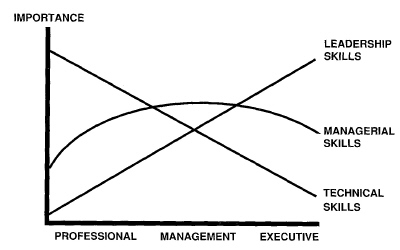
Professional (Entry/Personal Contributor): Technical/functional
skills (what you can personally do) are most important at this stage;
managing the work of others and personal leadership skills are not yet
critical.
Management (Middle Management/Supervisor/Manager of Managers):
Getting the work out through others (which requires people and process
management skills) is at its peak at this stage; technical skills begin a
gentle decline, and leadership skills begin to come into play.
Executive (General Manager): Leadership skills are the most critical
at this stage; detailed technical skills are at the lowest, and management
skills have plateaued in the middle.
Table 5 - How Important Are These Job Aspects?
1. Evaluate Staff Professionals for Management Potential and Intent
Early
Although many staff professionals prefer to remain individual contributors,
it's not true that most don't want to be managers or couldn't make better
managers if given proper preparation and opportunity. Roughly 40% of Fortune
500 CEOs had their primary background in finance and law, so success is not
so much based on where or how one started as it is based on one's later
experiences.
The AT&T studies (Bray, Campbell, & Grant, 1974) found that 29% more of
low-assessed managers were promoted than the high-assessed if the former had
more challenging jobs. Many staff managers don't get these early
opportunities. The CCL studies found staff executives whose first real
supervisory experience took place around age 40; for line executives the
experience occurred on average at age 23. Moreover, managers (line or staff)
that encountered their first leadership challenge at mid-career tended to
fail. By then the stakes were too high and the tolerance for mistakes was
lower, and people whose background included many technical projects with
similar groups of people were less prepared than those who had encountered
start-ups and fix-its and had managed varied groups of people previously.
Early identification of those staff contributors who show signs of
managerial and leadership potential and interest is the first step toward
providing them with opportunities for leadership challenges. Although most
staff professionals are evaluated early, these evaluations generally
concentrate on technical rather than leadership and management skills. . . .
2. Ration Development Jobs Carefully
Because supervisory roles are key sources for learning leadership skills,
and because they are scarcer in staff units (which are flatter than line
units), these positions should be reserved for staff who are identified
early as showing a potential for management.
3. Enrich (Provide More Variety in) the Leadership Experiences of Staff
Managers
When reassigning staffers, think in terms of a stark transition from one
type of challenge to another. Managers develop most when leadership demands
change—for instance, when they have to work with new people or technologies
or develop a new skill—and they must give up old ways to accomplish a task.
So organizations should ask such questions as, "What will this person have
to learn quickly? What will the person have to unlearn, give up doing, or
change?" In other words, when placing an individual in one of two possible
staff assignments, choose the one that offers the most change, thereby
providing diversity and variety for the developing individual. That strategy
will provide the opportunity to develop resourcefulness and the capacity to
learn on the run, two important leadership skills.
4. Think Small
There are a limited number of high-challenge jobs in any staff organization
and they should be rationed carefully. In addition, many mini-opportunities
exist: organizing an off-site meeting or developing a new training program
(mini-start-ups); working with a problem subordinate (a mini-turnaround or
fix-it); confronting morale problems, cutting costs, or streamlining
operations; giving someone a stretch project assignment. These can all teach
how to develop others and involve working with those not worked with before.
Eventually such small experiences can add up to a big one.
5. Use the Principle of Progression
Those who are successful start-up managers at age 40 often had mini-versions
of such work earlier in their careers. At age 23 they helped create a
word-processing pool and selected the first people; at 28 they started up a
small unit; at 33 they started up a new product; at 36 they were the number
two person in a major start-up; and then at age 40 (an overnight success!),
they handled a major start-up themselves. These chains of small but
progressively more challenging opportunities are available in most staff
organizations.
6. Provide Lots of Career Information and Feedback to All Staff Managers
and Professionals
In order to take an active part in their own development, staff
professionals need three things: an understanding of how the organization
defines effectiveness and success (and ineffectiveness and derailment), a
knowledge of what experiences (in terms of jobs and job challenges) can lead
to the competencies that constitute effectiveness, and frequent and varied
feedback on their progress in attaining these competencies. The first two
are sometimes problematic. Too often, the success profiles of organizations
are wish lists of desirable values and characteristics, with no indication
of where and how one attains these. Orientation courses and sessions in
which senior managers talk about their key experiences and learnings can
help in this regard, but nothing can substitute for a clear definition by
the organization of what constitutes effectiveness and how it can be
attained. The third is crucial. Staffers should receive
multiple-perspective, 360-degree, actionable feedback (that is, from bosses,
subordinates, peers, colleagues, customers, and so on) on their strengths
and weaknesses, and this feedback should be received on a regular basis.
7. Aggressively Help Staffers Learn from Each Experience
One of the main conclusions from the CCL studies is that successful people
are active learners. For instance, they keep notes on interesting ideas,
consolidate their learning through feedback or tutoring, or ask themselves
probing questions: What am I learning? What do I need to do differently?
What habits have gotten too comfortable for me? What do I need to do from a
leadership perspective? Such an orientation is not at all automatic. It's
easy to go along, absorbed in one's job, without reflecting on how one is
acting, what the impact of one's actions is, and whether one is developing
into a versatile manager able to cope with any leadership challenge.
Organizations can support and help managers structure their learning. CCL is
just completing a study of active learners which should give us a better
idea of how to help individuals increase their learning from experience. At
a minimum, managers ought to debrief past experiences and review upcoming
ones with developing subordinates.
8. Find Ways for Staffers to Work on Line Issues
There are numerous ways that staffers can be put to work on line issues.
Assign staff to task forces working on line problems. Arrange periodic
line-oriented issue and problem reviews. Assign staff to work on line
projects. Require staff professionals to work regularly with line managers
on urgent problems. The key point is not to allow staff to work isolated
from the core business activity.
9. Urge Individual Staffers to Build Their Own Leadership Skills
Individual staff managers can take an active part in finding ways to promote
their own development and can help carry out most of the recommendations we
make here. They can be empowered to look for and volunteer for start-up or
fix-it projects, define what constitutes effective leadership in their
current positions and acquire feedback on how they are doing, seek out
contacts with line colleagues, take field trips, or take part in task forces
and committees on significant line issues and problems. In order to do this,
of course, they need to know what leadership competencies to develop and
what experiences promote those competencies.
10. Expose Staffers to Customers
Staffers do not have as much contact with outside customers (nor as much
exposure to the basic business) as those working in the field and line.
This isolation can be lessened by such measures as taking field trips,
working in customer service for short periods of time, conducting market
surveys, taking part in customer focus groups, and visiting customers. A
number of hotels and fast-food organizations require managers and staff
professionals from headquarters to spend a week or two every year doing jobs
in the field in order to better understand customers and the business.
11. Look for Line-like Jobs in Staff Units
There are small line-like jobs in most staff areas. These have more direct
measures of their effectiveness, tight repetitive time frames, and direct
stand-alone decision making on a daily basis than the usual staff job, and
they often involve managing larger groups of people.
Examples are jobs in payroll, accounts payable, and accounts receivable in a
finance unit; jobs in compensation and benefits processing in a human
resource unit; or jobs managing the hardware and report generation in an MIS
unit. It might be tough to get high-potential staffers to take such jobs,
since they often would rather plan, think, strategize, and influence than
manage, direct, and oversee production. Some gentle persuasion might be
required. These mini-line jobs can help build leadership skills.
12. Look for Opportunities for Temporary Staff-to-line Switches
Staff-to-line switches are rare, but they should be used more frequently.
They can be very beneficial because they provide staffers with a specific
understanding of the leadership requirements of line work. In general, such
a switch should take place early in a career rather than late. If a full
switch cannot be provided, a halfway step could be considered. For instance,
a staff person could be sent into a staff unit within a line unit—perhaps
market research in marketing or sales planning in sales.
13. Look to Make Early Permanent Staff-to-line Transitions
Some staffers who show an early inclination toward management, leadership,
and the line should be moved into the line permanently as soon as possible.
This is especially important for women and minorities, who are bunched up in
staff groups. Look for likely transition points. Some organizations, in
order to persuade more to take the chance, offer a "round-trip ticket" in
case the transition does not work out.
14. Look to Experiences in Addition to Jobs
Because staff jobs and careers offer impoverished leadership opportunities
but the realities of business don't allow people to move around as much as
is desirable, staffers can enhance their development by means of off-the-job
projects and assignments—for instance, trips, projects, task forces, and
special assignments.
15. Look to Outside-of-work Experiences
There are leadership challenges in church groups, community projects,
charitable activities, and professional associations, and the staffer should
be encouraged to make use of these developmental opportunities.
16. Make Staff Services More Customer-focused by Using a Charge-back
System
Some organizations have a system of internally charging for the products and
services supplied by staff units. The practice is increasing as the
implementation of total-quality programs, with their concern with internal
and external customer requirements, increases. In advanced charge-back
systems the line can make choices between inside and outside sources of
staff services. They can also choose not to use the service at all. Although
staff charge-back is not appropriate everywhere and not always desirable, it
can make staff managers more sensitive to the nature of line work because
the products and services they are responsible for must meet line (customer)
needs; also, it provides a more direct measure of their effectiveness. And
because the line can go elsewhere if staff costs are too high or products
and services unsatisfactory, staff managers have to concentrate on
competition, cost-effectiveness, and quality. Charge-back systems, then, can
not only improve staff products and services but also increase the
opportunities for development of staff managers.
17. Implement Total Quality Management in Staff Units
The total-quality management process has many leadership challenges embedded
in it. Thus, managing a staff unit according to the idea that its products
and services be cost-effective, have zero defects, and totally satisfy
internal users can be beneficial to the manager's development: It has
elements of both start-up and fix-it assignments; it involves fairly complex
strategies of implementation; it has a heavy measurement and feedback
component and necessitates full delegation practices; and it aligns staff
and line more closely as both try to be more competitive in a global
marketplace.
18. Mix Line and Staff in Training and Development Programs
Where possible, training and development programs, whether internal or
external, should include the participation of both line and staff managers.
Everyone would gain from this mixing strategy.
19. Use Line Executives on Temporary Staff Assignments as Special
Mentors/Coaches for Staffers
Line executives who are temporarily assigned to staff positions can be used
as a developmental resource. They can be asked to coach one or more staff
colleagues in line experiences and perspectives. They can act as presenters
or discussants in staff management development programs. They can attend
meetings of staff units and provide a line outlook on the initiatives and
program ideas under discussion.
20. Arrange for Staff Professionals to Attend Line Meetings and Off-sites
Often, line units hold off-site meetings that exclude staff units, and vice
versa. It would be a very useful developmental experience for staff
professionals to attend line off-sites and business meetings. Not only would
the content of such programs be beneficial for staffers, but the chance to
interact informally with line and field individuals would help decrease the
isolation that many staffers experience.
21. Move Key Staffers at Headquarters to Field Staff Jobs
If temporary line assignments or special assignments with line content and
exposure can't be arranged, move key future staff leaders to field locations
before their salaries are too high or they are too senior in the chain of
command for such a move. Doing a staff job at a plant, regional office,
sales location, warehouse, or other field location is at least half of the
way closer to the line, the business, and the customer.
22. Manage the Careers of Key Staff Talent More Aggressively
This is our most important general recommendation. It is harder to develop a
staff professional into an outstanding leader who can serve as either a
staff or line executive than it is to develop a line professional for this
purpose. Because developmental opportunities are fewer, there is less time
and less room for error, as well as a higher cost if a key job or special
assignment is missed. Consequently, special education is necessary for staff
executives responsible for the development of staff professionals. In
addition, human resource departments may need to provide special resources
for developing staffers. Finally, top management needs to be aware of the
special nature of developmental life for staff professionals, and should
support the extra efforts that are required to improve it.
Conclusion
In thinking about the difference in leadership competencies between the staff and line managers, we naturally considered whether there might be explanations other than the differences in their experiences. Maybe the difference in managers could be traced to differences in people when they enter the organization. Perhaps people self-select into staff or line careers based upon the precursors to leadership skills, with the more technically oriented going into staff and the leaders into line. We could find no meaningful evidence of that. We believe they start with the same foundation, or threshold of characteristics for leadership competencies, although they may differ in their beginning interests.Maybe staff and line jobs are different at the top. Perhaps staff jobs require less personal leadership and more technical expertise. If that were the case, developmental life for staff professionals would be all right because staff careers do build technical competence. Is it possible that staff executives don't need as much leadership competence? We find only differences in degree between line and staff roles, responsibilities, and jobs. The top jobs in both staff and line have the same requirement for personal leadership; they are more similar than different.
We are convinced, therefore, that staff development must be improved.
And there are real impediments, many of them structural, standing in the way of staff professionals who might develop into senior executives. The good news, however, is that this doesn't necessarily have to be the case. If we move in an aggressive yet disciplined way to add diverse leadership challenges to the work of staff professionals, and if we introduce these early in their careers, we can change this situation. The benefits of doing this are great: an increased pool of leaders for both line and staff functions, better leadership in staff units, and an increase in the number of women and other minorities making it into senior management positions.
©1990 The Center for Creative Leadership
Related Articles
- Making the Most of Developmental Assignments
Q&A with Author Cynthia McCauley - The 3Cs of Developing Leaders
By Ray Blunt
Related Books
Developmental Assignments: Creating Learning Experiences without Changing Jobs
The Lessons of Experience: How Successful Executives Develop on the Job