

Dynamic Followership
The Prerequisite for Effective Leadership
The following article was originally published in the Winter 2004 issue of Air & Space Power Journal. Reprinted here with the kind permission of Air & Space Power Journal.
- Editorial Abstract: Rather than encouraging leaders to mentor followers to "follow me" as an imitation learning imperative, leaders may mentor to specific and objective abilities/traits to create dynamic subordinates. These dynamic follower competencies form a foundation from which follower initiative can grow to leader initiative more naturally. The identified follower competencies help leaders focus their mentoring efforts. This approach encourages followers to develop fully, based on their personalities, strengths and weaknesses, and situational factors.
"We have good corporals and good sergeants and some good lieutenants and captains, and those are far more important than good generals."
-- Gen William T. Sherman
The present formula promotes the illusion of effectiveness, but it does not optimize institutional performance. How do we know this? A cursory review of retention rates among Air Force members indicates that among "followers," instilling institutional commitment continues to be a persistent problem. For example, according to Air Force Personnel Center statistics, the service seeks to retain 55 percent of first-term Airmen, 75 percent of second-term Airmen, and 95 percent of the career enlisted force. With the exception of fiscal year 2002 when stop-loss measures prevented separation actions, the Air Force has not met these modest goals for all three noncommissioned categories since fiscal year 1996.1 For crucial officer specialties, the story is not much better.
The Air Force’s rated career fields (pilots, navigators, and air-battle managers) consistently retain approximately 50–70 percent of their officers. Active duty service commitments and career incentive pays, however, tend to skew retention data in the aggregate. Nonrated operations officers (space, intelligence, and weather) retain 48–65 percent of their members, while mission-support officers elect to stay in the service at an average rate of 44 percent.2 Air Force efforts to boost these numbers tend to focus on "quality of life" issues—a catchall category that includes projects such as better pay, housing, and base facilities. All of these initiatives are important and appreciated, but they fail to address the role individuals play in accomplishing the unit’s mission as followers. Rather than focusing on the negative aspects of worker dissatisfaction, follower-development programs should take advantage of opportunities to instill/reinforce institutional values, model effective follower roles and behaviors, and begin the mentoring process.
Developing dynamic followership is a discipline. It is jointly an art and a science requiring skill and conceptualization of roles in innovative ways—one perhaps more essential to mission success than leader development. Without followership, a leader at any level will fail to produce effective institutions. Valuing followers and their development is the first step toward cultivating effective transformational leaders—people capable of motivating followers to achieve mission requirements in the absence of hygienic or transactional rewards (i.e., immediate payoffs for visible products). This shift away from transactional leadership demands that we begin developing and sustaining transformational followership to enhance transformational leadership. A dynamic followership program should produce individuals who, when the moment arrives, seamlessly transition to lead effectively while simultaneously fulfilling their follower roles in support of their superiors. This goal helps us identify a strategy for follower development. Just as studies have identified desirable characteristics for effective leaders, so can we propose follower competencies upon which to base follower development in terms of specific skills and educational programs to advance critical thinking toward sound judgment. This approach demands that leaders recognize and fulfill their responsibilities in developing specific follower attributes or competencies within their subordinates. Leadership-development experts have proposed models for identifying desirable traits in leaders; similarly, followership studies can benefit from the discipline inherent in model development. A model that concentrates on institutional values and follower abilities would provide a starting point for synergistically integrating leader-follower development programs. As leaders capitalize on their followers’ competencies, they will equip their organizations’ members to achieve the visions they articulate for mission effectiveness.
Revolutionizing Traditional Leader-Follower Roles
Institutional changes in leader-follower roles and relationships lie at the root of why the Air Force needs to engage in dynamic followership programs to enhance its warrior culture. These shifts mirror similar shifts in business and industry. One researcher notedincreasing pressure on all kinds of organizations to function with reduced resources. Reduced resources and company downsizing have reduced the number of managers and increased their span of control, which in turn leaves followers to pick up many of the functions traditionally performed by leaders. . . . Furthermore, the nature of the problems faced by many organizations is becoming so complex and the changes so rapid that more people are required to solve them. . . . In general, making organizations better is a task that needs to be "owned" by followers as well as leaders.3
Corporate downsizing, increased pressure to deliver results, and increasing span of control for leaders are familiar concepts to military members. What some businesses and military institutions have missed as these pressures exerted themselves on leader-follower cultures is that leaders have ample opportunity to learn strategies and techniques for coping with change in the workplace. Followers, however, generally face two choices: (1) undergoing on-the-job learning that levies leadership responsibilities on them without commensurate authority or (2) entering a defensive crouch against the increasing workload. Both choices erode individual morale and institutional mission effectiveness—neither proves effective for producing capable followers within our Air Force.
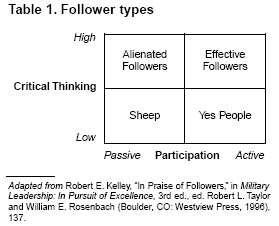
According to Robert E. Kelley, a prominent social scientist in followership studies, "What distinguishes an effective from an ineffective follower is enthusiastic, intelligent, and self-reliant participation—without star billing—in the pursuit of an organizational goal." Zeroing in on the task of developing followers, Kelley argues that "understanding motivations and perceptions is not enough."4 He focuses on two behavioral dimensions for determining follower effectiveness: critical thinking and participation.
Critical thinking involves going beyond collecting information or observing activities passively. It implies an active mental debate with things or events that we could otherwise process at face value. The active, independent mind confronts the situation and scrutinizes it closely, as if to stand it on its head or on its side, conducting a thorough examination of its far-reaching implications or possibilities. Many current, successful leaders cite critical thinking as a behavior they expect of their most valued followers. As for the concept of participation, a person engaged actively and comprehensively brings to mind an image of someone "leaning forward" into the situation at hand. This posture enables the person and those he or she affects to be in a position to anticipate requirements and plan accordingly. Conversely, passive individuals remain trapped in a perpetually reactive mode, placing themselves at the mercy of the prevailing current rather than preparing for impending tidal changes. In combination, critical thinking and participation generate four follower patterns.
Kelley argues that effective followers tend to be highly participative, critical thinkers. This type of person courageously dissents when necessary, shares credit, admits mistakes, and habitually exercises superior judgment. Kelley suggests that this follower possesses several essential qualities: self-management, commitment, competence (master skills) and focus, and courage (credibility and honesty).5 Although many people would recognize these traits as leadership competencies, according to Kelley, they remain paramount to the supporting role a follower plays. This type of follower represents the essential link between leader and follower cultures. As leaders develop and transmit the institution’s "big picture," they naturally turn to such individuals to help them communicate that vision to the rest of the institution. The effective follower’s invaluable perspective permits others to separate the essential tasks required for mission accomplishment from the minutiae. As the leader leads, the follower actively participates in task completion toward mission accomplishment; the leader-follower relationship produces the dynamics necessary for the team to accomplish the mission. Those who prove able to follow effectively usually transition to formal leadership positions over time. More than any other measurable attribute, this phenomenon clarifies the interactive nature of the leader-follower relationship.
Kelley characterizes the other three follower types (table 1) as follows:
"Sheep" are passive and uncritical, lacking in initiative and sense of responsibility. They perform tasks given them and stop. "Yes People" are livelier, but remain an equally unenterprising group. Dependent on a leader for inspiration, they can be aggressively deferential, even servile. . . . "Alienated Followers" are critical and independent in their thinking, but fulfill their roles passively. Somehow, sometime, something "turned them off," prompting them to distance themselves from the organization and ownership of its mission. Often cynical, they tend to sink gradually into disgruntled acquiescence.6
Kelley offers an important observation with regard to some followers’ influence on some leaders, cautioning that the latter remain comfortable with—or even embrace—the "yes people" or other less effective followers. Follower development is a leader’s utmost responsibility. Willingness to move beyond comfort zones is fully expected of tomorrow’s leader. Emerging security threats demand that we do so.
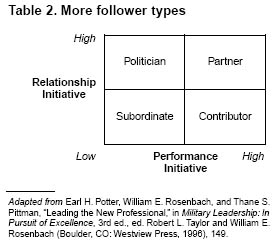
Other researchers describe a somewhat similar approach to followership studies. From this perspective, effective followers are "intent on high performance and recognize they share the responsibility for the quality of the relationship they have with their leaders. . . . They know they cannot be fully effective unless they work in partnerships that require both a commitment to high performance and a commitment to develop effective relationships with partners (including their boss) whose collaboration is essential to success in their own work."7 This perspective illuminates two ideal follower-competency dimensions—"performance initiative" and "relationship initiative." Within those dimensions are descriptors (or subscales) we could call competencies. They suggest that the ideal follower would act like a partner in the leader-follower relationship.
Performance initiative, a commitment to the highest levels of effort, includes the following:
- Working (effectively) with others. Followers balance personal interests with the interests of others and discover a common purpose. They coach, lead, mentor, and collaborate to accomplish the mission.
- Embracing change. Followers are committed to constant improvement, reduction of all types of waste, and leading by example. They are change agents.
- Doing the job (competence). Followers know what’s expected, strive to be the best, and derive satisfaction from applying the highest personal standards. To them, work is integral to life.
- Seeing one’s self as a resource (appreciating one’s skills). Followers understand their value to the organization and care for themselves as assets/investments.
These competencies point to team builders who "lean enthusiastically into the future" and always strive to be the best.
Relationship initiative, which acknowledges that followers share the responsibility with leaders for an effective relationship and work to increase openness and understanding to increase perspective around informed choices, includes the following:
- Building trust (core values; their word is their bond). Followers invite honest feedback and share plans and doubts. They are reliable and earn their leader’s confidence.
- Communicating courageously (honest, timely feedback). Followers tell unpleasant truths to serve the organization. They seek the same from others and risk self-exposure.
- Identifying with the leader. Followers are loyal to their "partner in success" and take satisfaction in the leader’s success.
- Adopting the leader’s vision (seeing the big picture from the boss’s perspective). Followers know the limits of personal perspective and actively seek others’ perspectives for greater team effectiveness. They have a clear understanding of priorities.
These dimensions allow us to characterize additional follower types (table 2). The "politician" possesses interpersonal qualities that might be misdirected and underappreciates job performance. "Subordinates" are traditional followers, content to do whatever they are told. They might be disaffected or simply unaware of the possibilities for greater contribution. Lastly, "contributors" are workhorses and often a creative force. However, they could maximize their inputs if they put energy into understanding the boss’s perspective, gained through relationship building. It is the "partner" who blends exceptional work performance with perspective gained from healthy relationships to both the leadership and peer group.
If we summarize what these prominent research approaches offer followership studies, we might characterize effective followers in these terms: individuals with high organizational commitment who are able to function well in a change-oriented team environment. Additionally, they are independent, critical thinkers with highly developed integrity and competency. Thus, effective followers exhibit loyalty to the boss by endorsing organizational vision and priorities. A true-life example illuminates these observations and makes the point even more effectively.
In his book American Generalship, Edgar F. Puryear Jr. interviewed Secretary of State Colin Powell and asked him why he believed he was selected to be chairman of the Joint Chiefs of Staff. Powell replied,
Beats me. I worked very hard. I was very loyal to people who appointed me, people who were under me, and my associates. I developed a reputation as somebody you could trust. I would give you my very, very best. I would always try to do what I thought was right and I let the chips fall where they might. . . . It didn’t really make a difference whether I made general in terms of my self-respect and self-esteem. I just loved being in the army.9
So the question becomes, How do we develop such individuals?
The Case for Effective Follower Development
There may well be legitimate disagreements about which follower competencies should have priority over others or which competencies belong more to leader development versus follower development. Nevertheless, it is useful to talk about the prime mechanism by which followers learn behaviors or competencies important to their success: mentoring.Edgar H. Schein discusses the ways that leaders create cultures, including expected behaviors, through six "embedding mechanisms," one of which is "deliberate role modeling, teaching, and coaching." He relates a story that illustrates how to teach desired behaviors by example:
The Jones family brought back a former manager as the CEO [chief executive officer] after several other CEOs had failed. One of the first things he (the former manager) did as the new president (CEO) was to display at a large meeting his own particular method of analyzing the performance of the company and planning its future. He said explicitly to the group: "Now that’s an example of the kind of good planning and management I want in this organization." He then ordered his key executives to prepare a long-range planning process in the format in which he had just lectured and gave them a target time to be ready to present their own plans in the new format.
By training his immediate subordinates this way, he taught them his level of expectation or a level of competence for which they could strive. This overt, public mentoring technique—or as Schein would characterize it, "deliberate role modeling, teaching, and coaching"—is key to developing effective followers.10
Effective leaders acknowledge that their perspective influences their subordinates. Leader priorities become follower priorities. The leader transmits those items of concern by many means—some directly but others indirectly or according to context. As long as followers clearly understand the leader’s expectations and necessary levels of competence, the actual amount of face-to-face time is generally not critical. Of paramount importance is leaders’ awareness of how their priorities and actions will set standards for their followers’ behaviors and values.
A mentoring culture is necessary to pass on the obvious and subtle values, priorities, behaviors, and traditions in an organization. In another interview in American Generalship, Puryear speaks with Gen Bill Creech, credited with revolutionizing the way Tactical Air Command (TAC, forerunner of Air Combat Command) went about its mission when he served as commander from 1978 to 1984. General Creech describes several of the 25 bosses he had during his 35-year career:
Only four of those bosses went out of their way to provide any special mentoring . . . to those of us who worked for them. And far and away the best of those four was General Dave Jones, whom I first worked for when he was the CINC [commander in chief, known today as the regional combatant commander] of the United States Air Forces in Europe (USAFE). . . . He painstakingly taught leadership skills, . . . drawing on his own experiences over the years, and he would take several days in doing so. . . . He provided lots of one-on-one mentoring that helped me greatly both then and over the years. It was those examples that I used as a baseline in setting up the mentoring system in TAC.11
Essentially, General Jones established a mentoring culture within USAFE when his followers emulated what he modeled. Reflecting upon our own experiences, we can conclude that not every member of our Air Force is mentored actively by his or her leaders. We have some evidence of efforts to establish the importance of mentoring, but as of this writing, a visible endorsement of mentoring by uppermost leadership remains in its infancy. Fundamentally, the most important contribution leaders make to their units and the Air Force is to ensure that the mission can continue without them. Our culture has a tendency to reward individuals who publicly stand in the limelight and to overlook those who do the "heavy lifting" behind the scenes. For that reason, embracing this contribution as the baseline for mentoring and translating it to everyday practice will remain problematic.
In this vein, one of the coauthors of this article tells an interesting story. As a second lieutenant, she encountered great difficulty with her supervisor, a first lieutenant, in aircraft maintenance. Their squadron commander—an "old school TAC" major—called them both into her office one day and conveyed this message: "Ollie, your job is to teach Vicki everything you know. If she fails when you leave the bomb dump, then you’ve failed. [Rast], your job is to learn. Dismissed!" That 45-second interaction, literally, was the end of that particular "mentoring" session (there would be many others!), but it had profound effects on both young officers in terms of the way they viewed their roles as leaders, followers, teachers, and mentors. Dr. Schein would suggest that this transformation in conceptualizing the leader’s role as one of developing followers—in essence, working one’s way out of a job—is a prerequisite for mentoring to take root.
Air Force Instruction (AFI) 36-3401, Air Force Mentoring, provides guidance to all Air Force members. It specifically charges all supervisors to serve as formal mentors to their subordinates. There is room for robust informal mentoring once the culture formally takes root. According to the instruction, "Air Force mentoring covers a wide range of areas, such as career guidance, technical and professional development, leadership, Air Force history and heritage, air and space power doctrine, strategic vision, and contribution to joint warfighting. It also includes knowledge of the ethics of our military and civil service professions and understanding of the Air Force’s core values of integrity first, service before self, and excellence in all we do."12
In concert with General Creech’s observations, AFI 36-3401 states that mentoring is the responsibility of leaders, requiring them—through direct involvement in subordinate development—to provide their followers with realistic evaluations of their performance and potential and to create goals to realize that potential. Importantly, the instruction encourages informal mentors: "The immediate supervisor . . . is designated as the primary mentor. . . . This designation in no way restricts the subordinate’s desire to seek additional counseling and professional development advice from other sources or mentors."13
Therefore, mentoring relationships are vital to followers who seek to understand the substance behind their leaders’ actions. What were the leaders’ options? Why do bosses elect to do what they do and when they choose to do it? Asked how one could become a decision maker, Dwight D. Eisenhower responded, "Be around people making decisions. Those officers who achieved the top positions of leadership were around decision-makers, who served as their mentors."14
Hands-on Follower Development
Let’s get more specific. Discussions of leadership development tend to focus on acquiring key, separate competencies rather than imitating a leader’s style. We suggest that followers can develop themselves in much the same way.15 Traditional leader styles (e.g., autocratic, bureaucratic, democratic, laissez-faire, etc.) are inadequate in dynamic, changing environments. Can any organization really afford to have a bona fide laissez-faire manager at the helm when the head office or major command mandates an overnight overhaul? Developing leadership competencies gives up-and-coming leaders a tool kit from which to draw, no matter the situation they might encounter.Dr. Daniel Goleman, the leading advocate of emotional intelligence, identifies five categories of personal and social competence: (personal) self-awareness, self-regulation, motivation, (social) empathy, and social skills. Looking more closely into, say, empathy, one finds specific competencies: understanding others, developing others, acquiring service orientation, leveraging diversity, and cultivating political awareness.16 He makes the point that each of us has areas in which we are more or less naturally competent. Some of us are more empathetic than others (because of early socialization, emotional disposition, etc.) and therefore more proficient in empathy’s specific competencies. But the less empathetic individual is not a lost cause because mentoring by senior leaders can enhance areas that need improvement.
If we use our hypothetical but plausible set of follower competencies as a template (leaders can adjust the competencies included here to meet their own cultural norms and values), we can extrapolate a follower-competencies development approach based on Goleman’s discovery work in leader-competencies development. He says that the follower requires behavior modification, monitored by the mentoring leader. Organizations must "help people break old behavioral habits and establish new ones. That not only takes much more time than conventional training programs, it also requires an individualized approach."17 So which follower competencies need deliberate development?
Plausible Follower Competencies and Components
After examining a variety of research, this article has distilled several follower competencies:- Displays loyalty (shows deep commitment to the organization, adheres to the boss’s vision and priorities, disagrees agreeably, aligns personal and organizational goals)
- Functions well in change-oriented environments (serves as a change agent, demonstrates agility, moves fluidly between leading and following)
- Functions well on teams (collaborates, shares credit, acts responsibly toward others)
- Thinks independently and critically (dissents courageously, takes the initiative, practices self-management)
- Considers integrity of paramount importance (remains trustworthy, tells the truth, maintains the highest performance standards, admits mistakes)
Our research leads us to believe that followers learn most effectively by observing the actions (modeled behavior) of an organization’s leaders. As Goleman points out, however, impelling adults to adjust their behavior often requires an individualized approach. Whether it’s called coaching (skill-specific training) or mentoring (a longer-term relationship), in order for leaders to correct follower-competency deficits, they must pay deliberate attention to development opportunities for each individual.
Tracking progress can occur through both formal and informal feedback. A mentor can ask the follower and his or her peer group how team-dependent things are going. How often is the suggestion box used? Are the suggestions well thought out? (Are they relevant to things on the boss’s mind?) One can use customer-satisfaction forms to measure some competencies . . . and the list goes on. Certainly, the most important check is the ongoing evaluation the boss makes throughout the developmental relationship with each follower.
Conclusion
We have explored followership, the one common denominator we all share as members of our culture, by briefly examining plausible competencies germane to effective following. We determined that these competencies should enable followers to become leaders almost effortlessly. By employing Schein’s discussion of the establishment of cultures, we made a case for leader involvement in the development of subordinates. Drawing on the followership studies by Kelley and others, we culled follower-specific competencies along the theoretical model of emotional intelligence suggested by Goleman’s competencies for leaders. Most importantly for further study, we established the need for Air Force mentoring—the vehicle by which our service can pass on its culture to new generations.In our look at the specifics for developing better followers, we discovered the existence of many overlapping requirements between effective leader competencies and dynamic follower competencies. By considering these thoughts about follower-unique opportunities to support the mission and by naming follower-specific traits and abilities, leaders may now focus on deliberate development plans for their subordinates. In the future, communication, appreciation, and efficiencies between leaders and followers should vastly improve as complementary and overlapping role requirements are articulated more effectively in terms of a competencies-based development approach for all.
Notes
- "Talking Paper on Air Force Military Retention," http://www.afpc.randolph.af.mil/afretention/Retention Information/Pages/General.asp (accessed 4 March 2003).
- Ibid. Special thanks to Col Chris Cain for offering this data and commentary.
- Richard L. Hughes, Robert C. Ginnett, and Gordon J. Curphy, Leadership: Enhancing the Lessons of Experience, 3rd ed. (Boston: Irwin McGraw-Hill, 1999), 32–34, 39.
- Robert E. Kelley, "In Praise of Followers," in Military Leadership: In Pursuit of Excellence, 3rd ed., ed. Robert L. Taylor and William E. Rosenbach (Boulder, CO: Westview Press, 1996), 136–37.
- Ibid., 138–41.
- Ibid., 137.
- Earl H. Potter, William E. Rosenbach, and Thane S. Pittman, "Leading the New Professional," in Military Leadership, ed. Taylor and Rosenbach, 148.
- Ibid., 149–50.
- Edgar F. Puryear Jr., American Generalship: Character Is Everything: The Art of Command (Novato, CA: Presidio Press, 2000), 229.
- Edgar H. Schein, Organizational Culture and Leadership, 2nd ed. (San Francisco: Jossey-Bass, 1992), 230, 241–42.
- Puryear, American Generalship, 218–19.
- Air Force Instruction (AFI) 36-3401, Air Force Mentoring, 1 June 2000, 2.
- . Ibid.
- Quoted in Puryear, American Generalship, 188.
- See Daniel Goleman, Working with Emotional Intelligence (New York: Bantam Books, 1998).
- Ibid., 26–27.
- Daniel Goleman, "What Makes a Leader?" Harvard Business Review, March–April 2000, 97.
Contributors
Lt Col Sharon M. Latour (BA, MA, University of California–Santa Barbara; MS, Troy State University; PhD, University of Southern California) serves on the faculty of the Department of Leadership, Command, and Communications Studies at Air Command and Staff College, Maxwell AFB, Alabama. She previously served as chief of protocol at RAF Mildenhall; assistant professor in the Behavioral Sciences Department at the US Air Force Academy; section commander in the 555th Fighter Squadron, Aviano, Italy; faculty member at Squadron Officer School, Maxwell AFB; and chief of professional military education policy at the Pentagon. Colonel Latour is a graduate of Squadron Officer School and Air Command and Staff College.
Lt Col Vicki J. Rast (USAFA; MPA, Troy State University; MMOAS, Air Command and Staff College; PhD, George Mason University) is an assistant professor of political science and chief of the Core Courses Division at the United States Air Force Academy, Colorado Springs, Colorado. She has served as director of operations, Joint Warfare Studies Department, Air Command and Staff College, Maxwell AFB, Alabama, and as aircraft maintenance and munitions officer, Shaw AFB, South Carolina. She led a munitions unit during Operations Desert Shield and Desert Storm and controlled planning and deployment of the 363d Fighter Wing during Operation Southern Watch. A distinguished graduate of Squadron Officer School and Air Command and Staff College, Colonel Rast is the author of Interagency Fratricide: Policy Failures in the Persian Gulf and Bosnia (Air University Press, 2004).
Disclaimer
The conclusions and opinions expressed in this document are those of the author cultivated in the freedom of expression, academic environment of Air University. They do not reflect the official position of the U.S. Government, Department of Defense, the United States Air Force or the Air University.
©2003 Air & Space Power Journal