

The Failures of Leaders
She was at the top of her game. A career civil servant, she was widely recognized as the most knowledgeable and powerful procurement official in the Air Force. Responsible for $30 billion in new weapon systems, she was a tough negotiator and contract monitor while also being highly innovative in her approach. She demanded high quality and fair prices for the government, and over the years she was responsible for savings of over $20 billion. No wonder she was recognized among the senior brass of the Pentagon as a top tier leader and a formidable force within the Air Force. She was not someone to be toyed with or crossed, but she got results and that’s what made her so valued as a leader. But then . . .The rest of Darleen Druyun’s story is not as pretty. It never is when your name appears in The Washington Post for improperly steering inflated contracts to a key defense industry manufacturer while arranging jobs for your daughter and yourself with that same contractor. What followed was a very public mea culpa, an apology to all concerned, and a jail term. Darleen Druyun unintentionally became a case study in ethics that keeps getting replayed for those senior leaders coming behind her both in the Air Force and the broader acquisition community. Those lessons may be the only positive result of this entire affair, but they came out of a spectacular and very public failure.
Leaders fail. Sometimes the failures play out in the media as Ms. Druyun’s did; sometimes the failures are well known within the organization; and sometimes the failures quietly exist and go on for some time with only a few people being aware but not saying anything. And, even more oddly perhaps, senior leaders themselves are often unaware of their own failures.
My point here is not to bash leaders for their failures, but to put failures into perspective and to see if we can all use them as a leadership lesson for development. Why? If you are a leader, you are going to experience failure. Accept that as fact. Hopefully, you won’t make The Washington Post or Government Executive, but you will fail at some point. Anyone who has been a leader will tell you this is true. (I can vouch for that myself, in spades.) So, what exactly are you going to do about it? Maybe the following discussion will help.
A Window into Failures
Many years ago, as a young captain in the Air Force, I was first exposed to something called the Johari window. The Johari Window (named after the first names of its inventors, Joseph Luft and Harry Ingham) is a model describing what each of us is like, as we are known both by others and by ourselves. The four-paned "window," divides personal awareness into four different types, as represented by its four quadrants: open, blind, hidden, and unknown.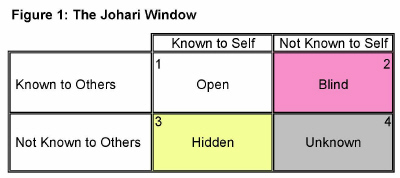
Every day, news headlines like those that featured Darleen Druyun provide for us the “open” window. We know about it, they know about it and the result (other than humiliation) is either confrontational denial or public confession. Often, denial is followed by the confession when a person finally comes to grips with doing the right thing as evidence mounts or as consequences become more serious for others involved. It is often these large, very public failures of others as leaders that perhaps contribute to creating blind spots in ourselves—we’re not THAT bad.
In the second window, there are failures in ourselves that others are aware of, but we are not. This was the case with Darleen Druyun --and is likely the case in most situations of leadership falling short. What happens? From what I have seen (in organizations and in myself), the leader has possibly not taken the most egregious steps yet, but the course they are on is clearly one of potentially larger failure. This typically manifests itself in a variety of ways, such as some degree of arrogance that is evident to many, strongly expressed anger visited on whoever happens to be in the way, or even retaliation against people who oppose them. The ancient Greek tragedies are filled with this failure, hubris they called it, which was always a precursor to worse things. It remains so today: human nature has not changed.
The failure at this point is that the leader has begun to fail the people around them by creating a climate of fear rather than an environment where it is safe to give the boss feedback. They make the work more about themselves than others. These leaders often tell themselves that they have done nothing illegal and that their work is essential to the organization’s results. They come to believe they can do anything because that is how it has been reinforced for them. The danger here is twofold: (1) without understanding where they are falling short, leaders perpetuate their poor performance, especially as it impacts others; and (2) pride and arrogance lead to greater potential failures. From this point is is only a short and very slippery slope to more serious failures.
It is in the third window, where we recognize things in ourselves that others do not yet know, where failure can best be headed off early. It is here where our beliefs begin to be tested in the crucible of growing power. I am confident that none of us starts out in public service with the intention of failing our people and our government. Quite the contrary. A commitment to serve others and to serve the American people does not suddenly evaporate when we encounter an opportunity to abuse our power for personal gain. Our commitment and humility are continually tested from the time we take on our first leadership roles. It is in this window into us that the seeds of public failure are either sown or are rooted out. So where do we begin?
Heading Off Failure
Honest self-awareness in a leader must begin as a daily discipline before power begins to drown it out or the drive for results overcomes our desire to serve with humility. Many have found that such awareness comes from self-reflection and is often best practiced at the end of the day. Simply, quietly take stock and review your actions and relationships of the day. How often did you make the effort to serve others before yourself? Are you beginning to feel a sense of superiority over your colleagues or your boss? Begin to work on those areas where you know you are deficient.In my case, I began to realize that more and more of my time was being occupied by sitting at a computer, talking on the telephone, and going to meetings. I was simply letting my own agenda take priority over the agendas of the people that worked with me. It was one way I was expressing who and what was important--and I was wrong. Some timely feedback from a couple of friends and colleagues and my own reflection on what was said led me to make some changes. Gradually, I had to find some practices that caused me to interact with people, to listen to them, to take their careers and professional growth seriously. As an introvert, I knew I’d rather read and write than interact, but I had to force myself to change. In this regard, in my estimation, I was failing as a leader but it could have been worse had I not taken a second step I now often recommend to rising leaders.
Get yourself a wise mentor or something akin to a personal board of directors—people you meet with regularly who can be honest with you (and you with them) and who are discreet enough to be trusted to listen to your struggles and not broadcast them. We all need a community of people to get through this life well. We don’t always recognize that need at work, yet it is at work that we may need it most. Good mentors and good friends are worth their weight in gold, not just to avoid failure of course, but also to help us learn and grow.
There is Grace, Too
Finally, there is also grace, an acknowledgement and acceptance of our imperfections (and those of others) and a willingness to learn from our failures. In one of the finest books on leadership and character I know of, the authors of The Ascent of a Leader, advocate creating a culture of grace in our organizations and that we become leaders of grace. In doing so, we shape our own character and that of others for the good. They echo what John Kotter has said about organizations that create cultures that perform the best—they are organizations that drive out arrogance in leaders and drive out fear in the environment of work. It takes grace to do this.We began this conversation by observing that all leaders will face failure and that whether it is beyond their control or it is a direct result of their actions, the leader is out on the point when failure comes. As Jim Collins observes, the best leaders look in the mirror at such times and take responsibility; they don’t blame others. While I agree wholeheartedly, I would also make a strong case that we not only need to give others grace as he suggests, we need to give ourselves grace as well. Otherwise, the load of responsibility becomes too great or we become too timid to ever make a mistake again--and that begets a leader who is indecisive and lacks innovation. I had two close friends who were brilliant leaders who both became passive in the wake of failures that were not even their fault, and, as a result, public service lost their greatest gifts for service.
So, respect the potential for failure, be aware that we all struggle with the Jekyll and Hyde in us, and recognize that we all need both deeper self-awareness and a community around us to help avoid the trap that power can set. But when failure comes, as it will, learn from it and give yourself the grace to get back on the road again. Don’t become a casualty of failure; become fire tested with the internal tensile strength needed to resist the siren call of hubris so you can respond to the trumpet call of public service.
Have you struggled with hubris--or had to deal with its effects?
- 1. Bill Thrall, Bruce McNicol, Ken McElrath, The Ascent of a Leader: How Ordinary Relationships Develop Extraordinary Character and Influence, (San Francisco: Jossey-Bass, 1999).
- 2. John P. Kotter and James L. Heskett, Corporate Culture and Performance, (New York: Simon & Schuster, 1992).
- 3. Jim Collins, Good to Great: Why Some Companies Make the Leap and Others Don’t, (New York: HarperCollins, 2001).
©2007 GovLeaders.org