The Leadership Dilemma in a Democratic Society:
Re-energizing the Practice of Leadership for the Public Good
In July of 2001 a group of representatives from the National Security Agency
(NSA), the Environmental Protection Agency (EPA), Federal Energy Regulatory
Commission (FERC), Veterans Affairs (VA), National Aeronautics and Space
Administration (NASA), Health and Human Services (HHS), Food and Drug
Administration (FDA), Reserve Officers Association of the U.S. and the
Graduate school, USDA, began to meet monthly for the
purpose of re-energizing the practice of leadership for the public good.
Since July 2001 this group has asked itself many questions and continues to
ponder possible answers. One central question - Is there a natural conflict
between our elected constitutional process and structures, which directly
affect the practice of leadership for the public good? This leads to other
important questions: can we describe these structures in ways that would
help us learn together and begin the journey of creating more ideal public
sector workplaces, how can we overcome the barriers inherent in our system
of governance, that may no longer serve us well, who cares about the
practice of public sector leadership?
We began by telling stories that described the inherent leadership dilemmas
that each of us experienced in our workplaces. The agencies noted in the
first paragraph represent only a small percentage of the agencies whose
stories were told. Most of the participants have over 25 years of public
sector experience, and many have worked in multiple agencies. Our stories
evolved into themes, which were then developed into systems maps. We believe
the accompanying maps illustrate the current structures that have evolved
from our perceived national values and system of governance. The maps
reflect our collective experience and are designed to help us enlarge the
perspective as others enter the dialog.
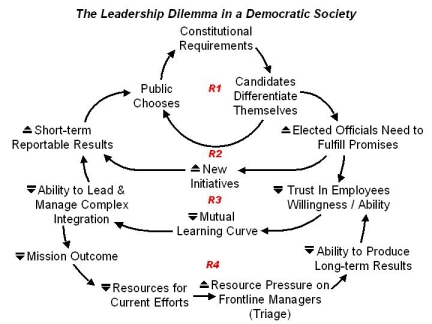
The first map describes the leadership dilemma in a democratic society which
results from a two party system competing for political gains and short-term
results. The second map captures the
lack of integration of new and existing
programs, which decreases agencies’ clarity of purpose and undermines the
capacity for leadership and effective public service. The third map
describes the inherent leadership dilemma for Senior Executives who are not
political appointees but pressured into a focus on short-term, and often
politically driven agendas. The fourth map attempts to capture
compliant
cultures born from the need for short-term results and continuous leadership
shifts necessitated by our election cycles. Finally our fifth map describes
the escalating complexity resulting from the manner our elected officials
respond to societal needs. This escalating complexity poses a barrier for
both civil servants trying to serve, and citizens trying to participate.
We are interested in creating forums for dialog throughout the country
because we believe that every citizen has a role to play in ensuring our
democratic system thrives. Our goal is to create a greater understanding of
the governmental structures, and collectively improve the larger system that
serves us. We invite you to use the maps in your own environment to engage
anyone who cares about the importance of leadership, the health of the civil
service and the quality of public service all Americans deserve.
*See PDF with large, high-resolution versions of the systems maps below.
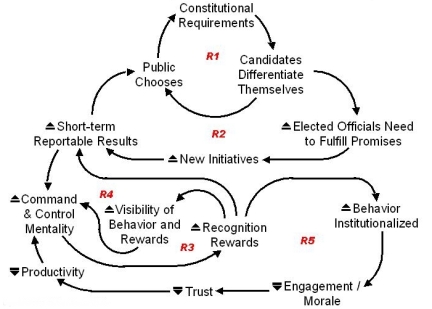
1. The Leadership Dilemma in a Democratic Society
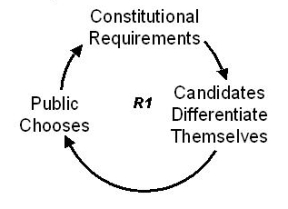
A. The constitution assures that Government represents the will of the people by
requiring elections. In an election, a candidate needs to differentiate
him/herself through a campaign. The will of the people is satisfied through
the election.
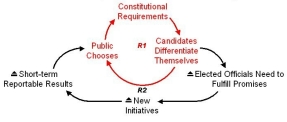
B. Once chosen the elected official through his/her appointees, is charged with fulfilling campaign promises, frequently through establishing new initiatives. The need to differentiate quickly drives a need for short-term results that can be reported to the public who elected the official.
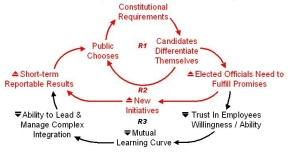
C. The campaign against incumbents
creates distrust of career civil servants who are perceived as keepers of
the status quo and thus suspected of resisting new initiatives. This
distrust leads to suspicion regarding attempts to educate the appointed
official and reduces the speed and effectiveness of the learning curve in
both groups. The slower learning curve, disparate views of stakeholders and
complexity of government systems inhibits the leader’s ability to manage the
difficult integration of new initiatives with ongoing efforts. The inability
to manage the complex system leads to focus on a few high visibility
initiatives that can be managed by the new incumbents and reported back to
the voting public.
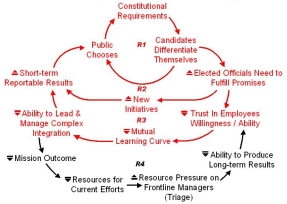
D. Without the integration of new initiatives within the organization’s existing work, the new efforts become additive and the highest priority. These new initiatives become the key focus of top ranking career civil servants leaving the rest of the on-going work to supervisors and managers. This increases the need for improved leadership at lower levels. Re-direction of resources to support new initiatives, and the lack of upper management focus on their efforts reduce management’s morale, and productivity. This leadership dilemma impacts the agency’s ability to produce effective long-term results. This further impacts the perception of career employees.
Summary of Map 1
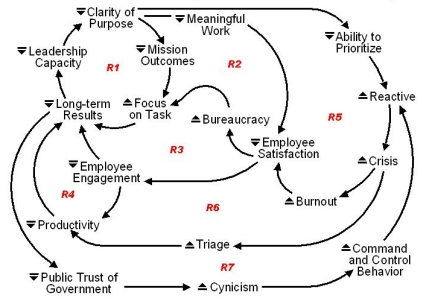
2. The Effects of the Leadership Dilemma
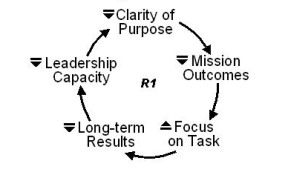 A. The lack of integration of new and existing programs decreases the agency’s
clarity of purpose. Most individuals are unable to see how they fit into what is
perceived as the important work of the agency. When clarity of purpose is lost
there is a shift from a focus on mission outcomes to a focus on day-to-day
tasks, with a consequent decline in long-term results that further reinforces
leadership effectiveness.
A. The lack of integration of new and existing programs decreases the agency’s
clarity of purpose. Most individuals are unable to see how they fit into what is
perceived as the important work of the agency. When clarity of purpose is lost
there is a shift from a focus on mission outcomes to a focus on day-to-day
tasks, with a consequent decline in long-term results that further reinforces
leadership effectiveness.
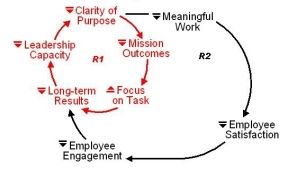
B. When clarity of purpose is lost employees lose the feeling that their work is meaningful. The feeling of meaninglessness leads to a loss of job satisfaction and a loss of employee engagement. Lack of engagement is reinforced by the loss of focus on results.
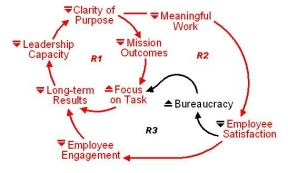
C. Lack of engagement and the consequent lowering of morale leads to a bureaucratic mindset and reinforces the focus on tasks.
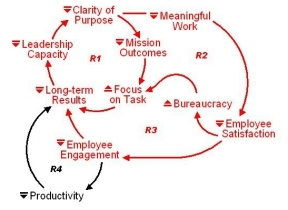
D. A further loss of engagement as a result of the task mind-set reduces productivity and long-term results.
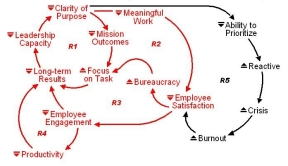
E. The inability to prioritize because of lack of clarity in purpose leads to a reactive approach to work, which causes a general drift from crisis to crisis. The constant crisis environment leads to frustration, burnout and further employee disengagement.
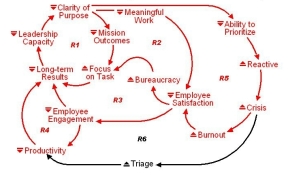
F. The crisis approach also leads to the need for constant resource triage with a consequent further loss in productivity and a worsening of long-term results.
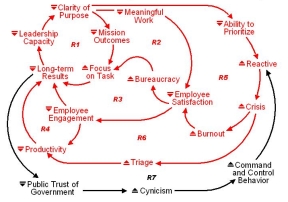
G. The trend of worsening of long-term
results leads to public and agency management distrust of agency employees,
which leads to more management suspicion about employee motives and work
ability and worker cynicism about the agency and its management. Cynicism
and suspicion fuel a stronger command and control approach by management
which leads to a more reactive mindset on the part of employees.
Summary of Map 2: The Effects of the Leadership Dilemma
3. The Senior Executive Service Leadership Dilemma
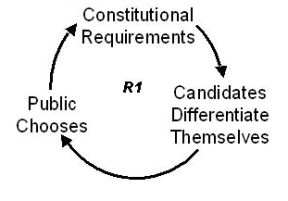 A.
The constitution assures that Government represents the will of the people by
requiring elections. In an election a candidate needs to differentiate
him/herself through a campaign. The election process is intended to satisfy the
will of the people.
A.
The constitution assures that Government represents the will of the people by
requiring elections. In an election a candidate needs to differentiate
him/herself through a campaign. The election process is intended to satisfy the
will of the people.
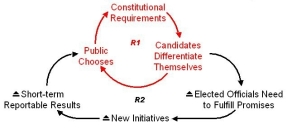
B. New political appointees place pressure on senior civil servants to fulfill election promises. In a micromanaged environment, short-term outcomes can be realized. As a result, an authoritarian manager is recognized, rewarded and promoted to more important positions.
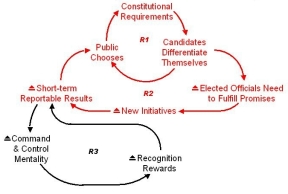
C. See above
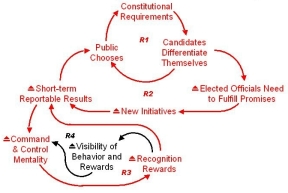
D. The reward for results achieved through a command and control approach is visible to employees and becomes perceived as the preferred behavior.
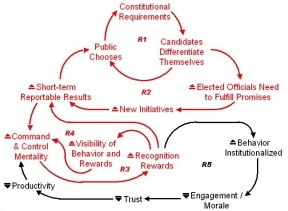
E. Senior leadership is recognized for “Results” in spite of the impact on employees and the organization. This institutionalizes this leadership style and reinforces an unintended consequence of reducing employee engagement and morale, feeding the distrust of employees and lowering productivity.
Summary of Map 3: The SES Leadership Dilemma
4. Culture of Compliance
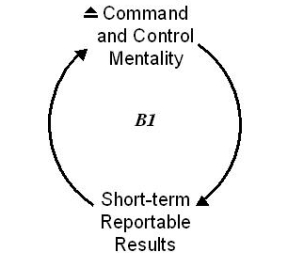
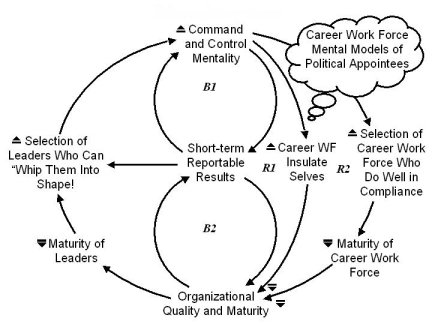
A. The pressure on elected officials in complex systems to create short-term reportable results often drives a command and control style of leadership. This style of leadership can occur when leaders have not had the benefit of developing working relationships with their colleagues that is based on mutual trust and understanding.
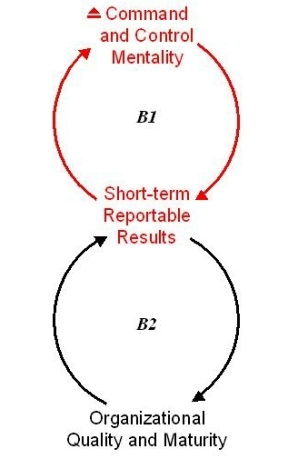
B. Long term reliance on a command and control style because of short-term goals or crisis undermines the quality and maturity of the workforce. It creates a dependence on being told what to do which also undermines innovation, creativity and initiative.
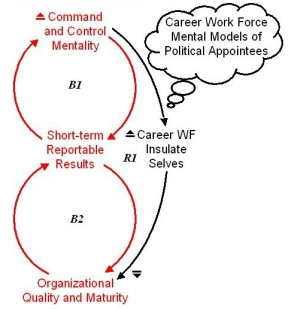
C. Because of the ongoing flux of the election cycle employees may attempt to insulate themselves from what they perceive as short- term initiatives. These new initiatives may not feel connected to the larger mission.
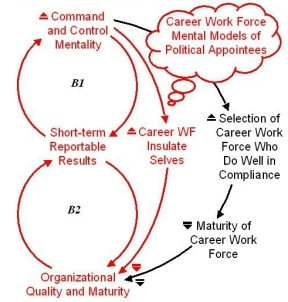
D. In a command and control culture employees are expected to take direction well and achieve results quickly. Employees who are comfortable with this culture of compliance rise quickly in the ranks and are seen as loyal and quick to deliver short-term products often working alone at the expense of team cohesion and maturity. This encourages the selection of managers who are comfortable with taking direction and working quickly on their own. This continues the erosion of the workforce maturity level and institutionalizes the “wait to be told culture.” In this culture the workforce can drift from crisis to crisis.
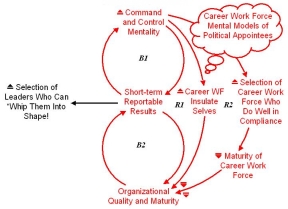
E. Leaders who are seen as real producers are often highly regarded by new political incumbents who have little history of them or their effects on the productivity of the workforce. This further encourages the selection of leaders who can get things accomplished quickly at a long-term price that goes unrecognized until there is a crisis.
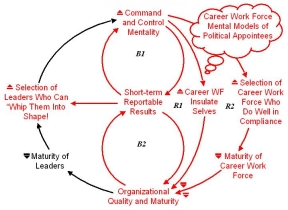
F. As the overall growth and maturity level of the workforce erodes, the selection of leaders and managers from this culture is also negatively affected. This adversely affects the organizations ability to select and develop leaders who take initiative, build a shared vision of success with their teams and create a climate of trust to achieve results.
Summary of Map 4: The Culture of Compliance
5. Escalating Complexity
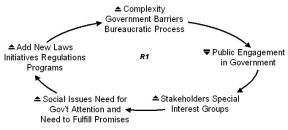
A. Government and public service institutions are called on to respond to societal needs. Political candidates create their campaigns around these issues. The response to societal needs often results in new laws, regulations or programs. These laws often serve the needs of special interests or attempt to resolve the immediate problem.
These “new” initiatives are frequently additive and create bureaucratic processes, which create barriers for internal civil servants as well as the public.
The more additive and complex the system becomes the greater the disengagement by both public sector employees and the public.
As the general public disengages the demands of special interest groups and stakeholders become a stronger force in shaping government policy and thus the law making process.
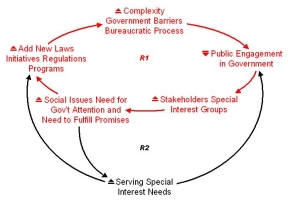
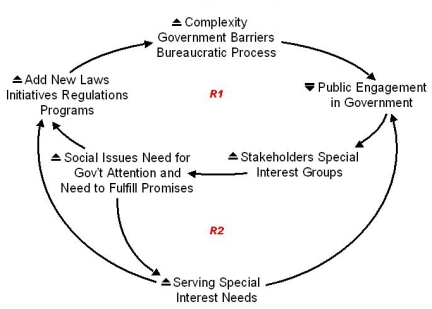
B. When government is perceived as responding to the needs of special interests and has not taken a systemic, integrated approach the public’s interest goes down.
In serving special interests, we increase the number of disconnected new laws and regulations, which further escalates the complexity.
People deal with the complexity by withdrawing completely, inventing ways to circumvent the system, or demanding reform and re-invention, which often adds to the complexity.
Summary of Map 5: Escalating Complexity
6. The Case for a New Leadership Model
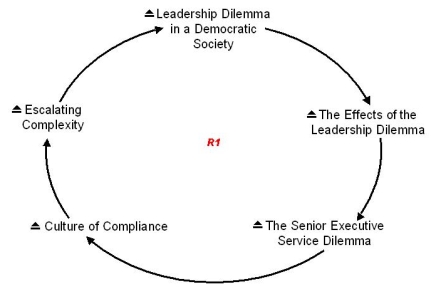
*See PDF with large, high-resolution versions of the systems maps.
The Leadership Dilemma
The democratic process and the need for elected officials to differentiate themselves lead to a need to deliver short-term reportable results. The complexity of government agencies, combined with the distrust which can result from political campaigns, make it difficult for newly appointed political leaders and civil service leaders to achieve long term outcomes together.
The Effects of the Leadership Dilemma
The inability of leaders to integrate new and existing programs decreases the agency’s clarity of purpose. When clarity of purpose is lost the shift from mission outcomes to a focus on day-to-day tasks further erodes long-term results and leadership capacity.
The trend of worsening long-term results leads to a poor perception of government and gives rise to cynicism.
The Senior Executive Service Dilemma
New political appointees rely on senior civil servants to help them fulfill election promises. Short-term results can be quickly achieved in a micro-managed authoritarian environment. Senior leaders are rewarded for achieving “results” in spite of the long-term impact on the employees or the organization. This institutionalizes a command and control leadership style with a short-term focus.
Culture of Compliance
Reliance on a command and control leadership style to achieve short-term results undermines the quality and maturity of the workforce. It creates a dependence on being told what to do which undermines innovation and initiative. As the overall growth and maturity of the workforce erodes the selection of leaders from this culture is also negatively affected. The perception that government is not innovative and does not anticipate necessary changes leads to the need to fix or re-invent government.
Escalating Complexity
Government and public service institutions are called on to respond to societal needs. The response to these needs often results in new laws and regulations. The more additive and complex the system becomes, the greater the disengagement by both public sector employees and the public. As the general public disengages, the demands of special interest groups become a stronger force in shaping the course of government policy and leadership.
Acknowledgements and Thanks
This project would not have been possible without the resource support and
leadership provided by The Center for Leadership and Management (formerly the
Leadership Development Academy) at the Graduate School, USDA and the generosity
of NASA.
Participation by members of the High Performing Federal Agencies Community of
Practice was supported by their respective public sector organizations.
Participants:
- Georgianna Bishop, Graduate School, USDA and
U.S. Environmental Protection
Agency - Anna Doroshaw, U.S. Environmental Protection
Agency and the Office of
Personnel Management - Kirke Harper, Graduate School, USDA
- B.T. (Skip) High, Department of Veterans Affairs
- Bette Novak, Department of Education and
Federal Energy Regulatory
Commission - Rebecca Pille, National Security Agency
- John O’Shea, Reserve Officers Association
- Ruth Salinger ,Department of Health and Human Services
- Pat Spitzig, Food and Drug Administration
- Chris Williams, National Aeronautics and Space Administration
Consultants:
- Richard Karash
- Wah Lee
- Frederick Simon
- Society for Organizational Learning
Historical Advisors:
- Dan Fenn Jr., Kennedy School of Government
- Louis Fisher, Library of Congress
- Heather Huyck, National Park Service
Technical Support:
- Ronald Mochinski, Contractor, National Aeronautics and Space Administration
- Avonne Washington, Graduate School, USDA
Electronic copies or information regarding the use of this material is available
by contacting the Public Sector Consortium at
info@public-sector.org.
The entire report and information about the Public Sector Consortium is
available at www.public-sector.org.
©2003 The Public Sector Consortium. Reproduced by GovLeaders.org with permission.