

On a Mission
Martin Luther doesn’t make many appearances in the pages of the numerous leadership tomes that reach bookstore shelves each year. And it’s a shame because he brought about earth shattering change to Europe for—good and for ill—and forever altered the religious landscape. History books use the term Reformation to describe the movement he helped launch. But what not many may know is that those in public service owe him a large debt of gratitude because he introduced the idea that a calling (i.e. a vocation) is of critical importance in secular life.
A Calling
In the Middle Ages, a calling was the sole province of the clergy. All others whether farmers, court jesters, artisans or housewives simply worked. For those who saw the recent film Amazing Grace, William Wilberforce’s conversion to faith showed this mindset. He was led to the conclusion that he could no longer serve in government, as it was such a nasty business. If it weren’t for John Newton’s advice that politics was his calling, Wilberforce might well have been an obscure country cleric rather than the brilliant Member of Parliament who led the abolition of slavery in England and much of Europe.
Luther’s contribution to today’s public service was to bring an understanding of a calling to serve others in the world as being the guiding principle in our vocation and a matter of great, personal importance.1 To serve others in any avenue of life is a high calling. What I want to introduce here for your consideration is that the vocation of public service as a calling—a high calling—is of critical importance to recruitment, retention, and motivation of people. And since it is a high calling, then we are called for a purpose and that purpose can be expressed much the way organizations have learned to do—as a personal mission statement. Each of us is (or should be) on a mission to which we have been called.
"If we can understand the connection between what we do and how the organization we are part of serves others, we will have a clearer long view that transcends our in-box."
Mission Importance
For several years as I taught in the Excellence in Government Fellows leadership program, I asked each of the Fellows to develop their own life mission statement. From feedback I received, most felt this was an important—and lasting—part of their learning. There are at least three good reasons a life mission statement is important for you.
For one, it exercises leadership competency muscles that are pretty flabby in many of us: self-awareness, reflection, service orientation, and strategic thinking. It is these skills, as we will see, that allow us to do this work. Second, it gives a focus and meaning for work and life that is unfragmented and can help sustain us when being nibbled to death by the ducks of a reluctant bureaucracy. Let’s face it, our day-to-day work can at times be boring, discouraging, disillusioning and may even seem unimportant. Knowing we have a clear mission will allow us to refocus or perhaps even relocate. And third, as Luther suggests, if we can understand the connection between what we do and how the organization we are part of serves others, we will have a clearer long view that transcends our in-box.
Mission Discovery
Let’s say you’re with me so far—possibly skeptical but at least willing to give it a try. So, how does one go about putting together a life mission statement? If Martin Luther can help us see better that we have a calling and that it is public service, and if William Wilberforce helps reinforce for us that public service can be as high a calling as any, then Stephen Covey is one to give it legs. It was from Covey that I first learned this lesson about a life mission and then began to teach it.
Writing in one of his lesser-known books, First Things First,2 Covey gives a clue to this work by quoting Victor Frankl, whose insight was that we don’t invent a mission rather we detect it.3 From that springboard, he describes an approach that each of us can use to better examine our inner lives. This is where it might get a little uncomfortable for some, but hang in there with me.
I can only briefly summarize Covey’s approach, but I would recommend the Appendix where he explains a personal workshop that can be done over a few days or even in one day. He also includes several sample mission statements that I found useful for some people who needed them to prime the pump.4
One exercise that helps to begin is the use of imagination to flash forward to an 80th birthday or a 50th wedding anniversary and to muse about what you would like said about you toward the end of your life. How would you want people to remember what you contributed to the world with others? Then take some time alone for reflection. Find a quiet spot, whether it is outdoors in a mountain setting, at a quiet beach or even a lawn chair in a secluded corner of your yard. The important thing is to be alone and to be uninterrupted by your cell phone, Blackberry, or PDA. Take a journal to write in. The substance of your work is to respond to a series of questions. The number is up to you. Covey posits 40 different questions in First Things First. When I did this exercise, I tried to boil it down to about ten, as time was limited. What you want to reflect upon is essentially how you have been uniquely wired.
What strengths have you demonstrated over time? Which activities have given you the greatest sense of accomplishment and happiness? What person has shaped your life the most significantly and what qualities do they have? Who are the most important people in your life? How are you doing spending time with them? What are you passionate about? Are you satisfied with the results of your life so far? What would you change in your life if it were only one or two things? What do you need to learn for the next stage of life? What does your day-to-day calendar reveal about you?
The next step is then to actually take what you are learning about yourself and to express it in a relatively simple statement, easily remembered, but that ties you back to all that you know about how you have been shaped and called over your life so far. It essentially answers the question, “Why were you uniquely placed on earth at this time?” Perhaps an example might help.
Two Great Objects
After his conversion and the affirmation of his calling, a young William Wilberforce wrote in his journal the following statement that guided his entire public career and private life over the years from age 26 until his death 46 years later:
"God has laid before me two great objects: The abolition of the slave trade and the reformation of manners."
His understanding of that mission led him to form alliances with an expanding group of intimate friends and colleagues who labored over the years together to accomplish just that—the abolition of the slave trade (and ultimately slavery)—and the reformation of manners (morals) in English society at the turn of the 19th Century. Under his leadership, Wilberforce’s colleagues in what became known as the Clapham Circle took on the rigid and selfish class society where the rich and privileged ignored the poor and dispossessed. In many ways, they were successful in this endeavor, helping usher in the Victorian era.
From this story we learn one other thing. While your life mission statement may not be as sweeping as Wilberforce’s, it does need to be large enough to energize your passions and gifts toward an end that will be a good legacy and will possibly inspire others to pursue it with you. This thoughtful, reflective process will take some time and probably some refinement over the years. Certainly mine has.
At almost 65 years of age, and having now arrived at something very simple and rather small as my mission for these last years, this is how I say it—“To help grow the next generation of servant leaders—and to be a servant leader.” I do have passion around that calling and I very much hope to sustain it until the end. In that I need lots of help and encouragement from others that are a much larger part of this public service leadership enterprise. Don Jacobson, the founder of GovLeaders.org and who serves those who frequent this website, is one of those I look up to.
Nike
Yes, just do it. Take the time. Make the time. This summer is a great season to start, as things slow down and maybe brains unlock for a time. Pick up a copy of Covey’s book or another that helps you accomplish the same end.5 Find a place to get away to. Then exercise those underused thinking and reflection muscles. One thing I do know about you without having met you is this: you were created not only equal, as we regularly affirm, but for a purpose. You are called to accomplish that purpose in your lifetime. Don’t wait to find your calling, your vocation, your mission until it is too late. Discover what your life is to be about.
Do you have a life mission statement? If not, get started with this Life Mission Statement worksheet.
1. Martin Luther, “The Freedom of a Christian” (1520),
in Luther’s Works, 55 vols., ed. Jaroslav Pelikan and Helmut Lehmann
(Philadelphia and St. Louis: Fortress and Concordia, 1955–1986) 31:346
2.
Stephen R. Covey, A Roger Merrill and Rebecca R. Merrill, First Things First: To
Live, to Love, to Learn, to Leave a Legacy, (New York: Simon and Schuster, 1994)
3.
Ibid, p. 110
4.
Ibid., pp. 305-321
5.
Two other sources I have used with profit later in my career and after
retirement were Half Time: Changing Your Game Plan from Success to Significance,
by Bob Buford, Zondervan, 1997; and The Purpose Driven Life: What on Earth Am I
Here For? by Rick Warren, Zondervan, 2007.
©2007 GovLeaders.org
Related Articles
- Life Mission Statement Worksheet
- Two Leaders--Two Legacies
By Ray Blunt
- The Toughest Choices a Leader Must Make
By Ray Blunt
Related Articles
Crossed Lives--Crossed Purposes
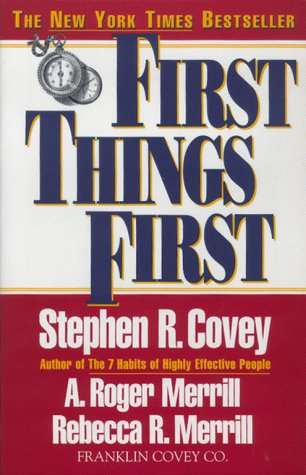
First Things First
Covey asserts that, in order to lead a fulfilling and productive life, we need to be clear about what we want to accomplish over the long term. First Things First will guide you through a step-by-step process to create a life mission statement which can serve as the underpinning of all that you do. This is a powerful way to clarify your priorities so you can align what is truly important to you with how you spend your time and how you appoach important life/career decisions. Read More...