

Making the Most of Developmental Assignments
Q&A with Author Cynthia McCauley
In her book Developmental Assignments: Creating Learning Experiences without Changing Jobs, Cynthia McCauley provides a superb framework to help leaders and aspiring leaders think clearly about how to use work assignments to develop leadership skills. McCauley, who teaches leadership at the Center for Creative Leadership recently discussed her book in a Q&A with GovLeaders.org.
GovLeaders: In order to prepare for the retirement of the Baby Boomers, many government agencies are focusing a lot of energy these days on leadership development--especially training and mentoring programs. The role of challenging and varied assignments seems to get relatively little attention. How important are these kinds of developmental experiences in the overall leadership development process?
CM: Our research indicates that challenging assignments are a major source of leadership development. When managers and executives are asked to describe key developmental experiences in their careers, 50-70% of the experiences they describe are challenges encountered in their assignments at work.
"When managers and executives are asked to describe key developmental experiences in their careers, 50-70% of the experiences they describe are challenges encountered in their assignments at work."
GovLeaders: Your book is an update to the very popular Center for Creative Leadership book Eighty-Eight Assignments for Development in Place. What have you and your colleagues at CCL learned about development in place since that book first came out in 1989?
CM: We’ve heard from a much more diverse group of managers about their developmental experiences. The original research was conducted in the early 1980’s and focused on senior executives in large corporations (mostly white males). Our data are now based on a more demographically diverse sample from across types of organizations and management levels. This led to a broader framework that describes ten types of developmental challenges—characteristics or features of assignments that stimulate learning (e.g., influencing without authority, fixing inherited problems, and working across cultures). We’ve also learned more about how people learn important lessons of leadership outside the workplace as they participate in community, professional, and service organizations—lessons that they can bring back and apply in the workplace. We’ve also seen an increased emphasis on how to work effectively laterally across the organization (rather than just through the chain of command), thus developmental assignments which give managers the opportunity to influence peers, work across boundaries, and gain an understanding of other parts of the organization are increasingly important.
GovLeaders: In the book, you indicate that one way aspiring leaders can broaden their experience is to “reshape” their job. How does one go about doing that?
CM: Reshaping your job means adding new responsibilities to your job. There are several strategies for seeking these new responsibilities. First is to talk with your boss. Is there something currently on his or her plate that could be delegated to you? Look for things that have become routine for your boss, but would be a stretch for you. Another strategy is to trade a responsibility with a colleague. The added bonus here is that you can serve as each other’s coach as you master the new work. A third approach is to take on responsibilities that are currently “falling through the cracks,” that is, work that would help your group or the organization but no one is paying attention to it. For example, one manager told us about starting a formal intern program for her organization. The organization sometimes made use of interns, but not in any systematic way. The manager learned more about work processes throughout the organization and honed her ability to spot and develop talent. A final strategy is to devote more time to an aspect of your job that could be developmental if you spent more time focused on it, for example, coaching employees or negotiating with vendors. Sometimes people avoid the parts of their job that they aren’t good at—a sure strategy for not improving in these areas.
GovLeaders: You also discuss temporary assignments as a great source of leadership learning. In government, however, the Civil Service system tends to make it difficult for people to move around flexibly. What kinds of mechanisms have you seen organizations use effectively to facilitate short-term developmental assignments?
CM: One approach is to educate bosses on using temporary assignments as part of employee development. It is most often the boss who gets the requests to assign one of his or her employees to a special project or task force, who knows that someone will need to fill in for an employee on temporary leave, or who actually creates a temporary assignment in his or her group. Certainly that boss wants to assign someone who has strengths that match the requirements of the assignment, but he or she should also think through who could benefit from the challenges embedded in the assignment. Organizations can support this process by requiring regular developmental planning conversations between supervisors and employees; these conversations create space to think more systematically about the kinds of experiences an individual employee could benefit from and primes the boss to be on the look-out for these opportunities.
I have also seen a few organizations post opportunities on an internal “marketplace.” These postings can include opportunities available for anyone in the organization, for example, serving on the coming year’s United Way campaign organizing committee, or opportunities within a group, for example, a new R&D project that needs additional assistance.
GovLeaders: What does it take for an assignment to be truly developmental?
CM: The developmental potential of any experience is enhanced when three elements are present: assessment, challenge, and support. Assessment includes the formal and informal processes for getting data about how you are doing in the assignment. Feedback from others is a common source of assessment, although self-reflection and getting reactions from a coach also provide assessment data. Challenge comes from being stretched by the assignment due to encountering new tasks, new responsibilities, increased demands, or more complex situations. Support helps people deal with the struggles of a challenging assignment. Support usually comes from coworkers, but can also come from family and friends. Our advice for making the most of an assignment is to create a development plan that calls out the challenge you will face in the assignment and articulates strategies for getting the assessment and support you will need to maximize learning from the assignment.
Examples of Challenging Assignments
| Type of Challenge | Ideas for Assignment |
Unfamiliar responsibilities:
|
|
New directions:
|
|
| Inherited problems:
|
|
Problems with employees: Dealing with employees who lack adequate experience, are incompetent or are resistant to change. |
|
High stakes: Managing work with tight deadlines, pressure from above, high visibility and responsibility for critical decisions. |
|
| Scope and scale:
Managing work that is broad in scope or large in size. |
|
External pressure:
|
|
| Influence without authority:
|
|
Work across cultures: Working with people from different cultures or with institutions in other countries. |
|
Work group diversity:
|
|
GovLeaders: Is there anything else you would like to add?
CM: I would just want to emphasize that there are many developmental opportunities available to us. You don’t have to wait on a major job move or a formal program to continue to learn and grow. It does take knowledge of yourself (i.e., where the gaps are in your knowledge, skills, and abilities), creativity, and persistence.
©2007 GovLeaders.org
Related Articles
- 22 Ways to Develop Leadership in Staff Managers
By Robert W. Eichinger and Michael M. Lombardo - Learning to Ride a Bike--and to Lead
By Ray Blunt - Using IDPs to Leverage Strengths
By Don Jacobson
Related Books
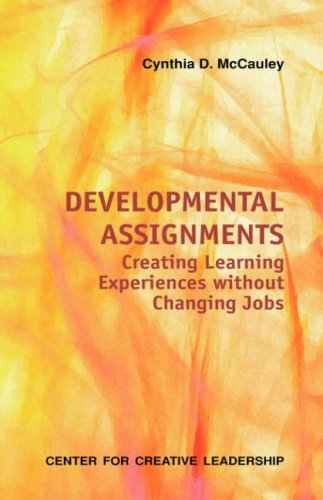
Developmental Assignments: Creating Learning Experiences without Changing Jobs